Can China relieve rural poverty with All-for-one Tourism Zones?
Struggling communities throughout China are hopeful that a new initiative will distribute the benefits of tourism. But when implementation means waiving ticket fees for attractions and evicting villagers, local governments and residents balk.
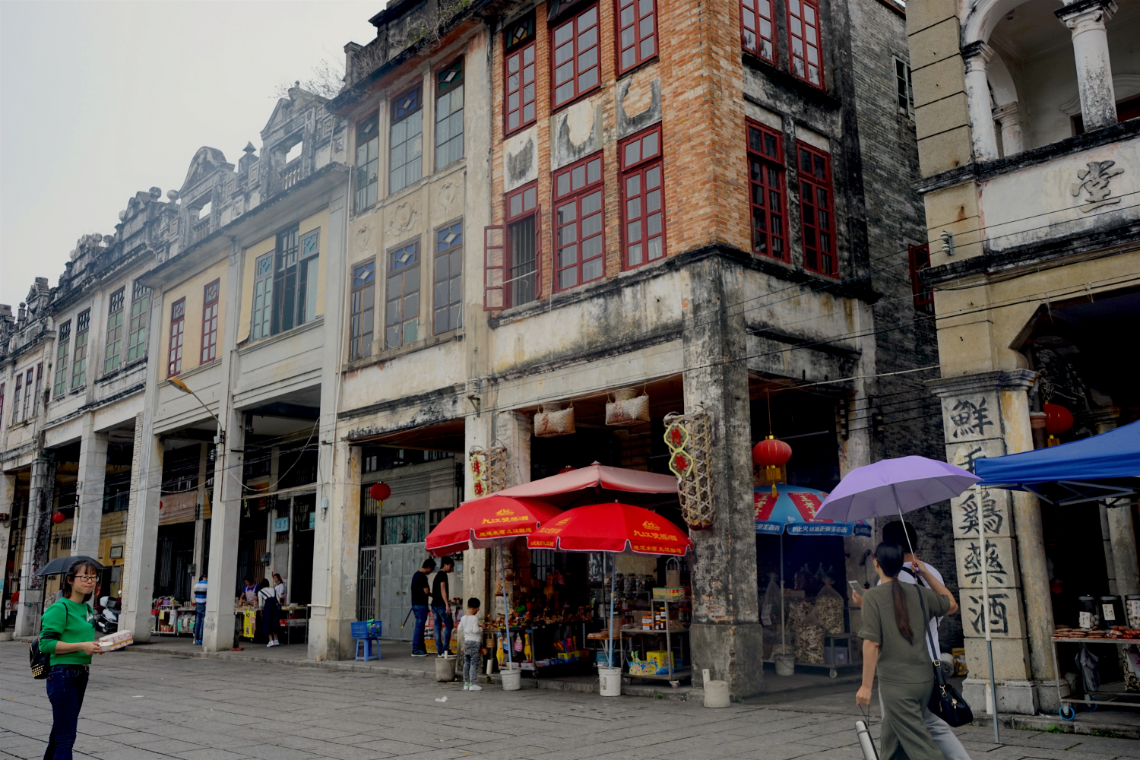
On the historic waterfront of Chikan (赤坎 chìkǎn), in southern Guangdong Province, multicolored umbrellas are displayed for sale outside an early 20th-century arcade. Shopkeepers sell home-cooked Chinese medicine and peanut brittle. In one display, a children’s toy piano has misarranged piano keys, but the shopkeeper doesn’t mind. “It’s a children’s toy,” he explains.

It’s a tranquil scene, but it might all change soon: In April, the Guangzhou provincial government announced (in Chinese) a 6 billion yuan ($875 million) renovation of Chikan Old Town. The plan will cover almost 4,000 historic homes and will require several years to complete. The project is part of China’s new “All-for-one Tourism Zones” (全域旅游 quán yù lǚyóu), promoted by Premier Li Keqiang at this year’s annual Party Congress three months ago.
All-for-one Tourism Zones aspire to expand the scope of tourism in China. “The traditional model of attraction-based tourism is no longer sufficient,” writes (in Chinese) Li Jinzao 李金早, director of China’s National Tourism Administration. According to a slick 30-second promotional video, the new model will promote “rural,” “industrial,” and “senior-friendly” tourism. The All-for-one Zones will “dissolve” barriers — such as admissions tickets and officially appointed tour guides — between tourist hot spots and the surrounding town, and promote the “integration” of town and tourist amenities. Growth in market size will offset the loss of revenue from entry tickets and tour guides. At the same time, the benefits of tourism will be distributed more widely among the population.

Poverty alleviation is a major goal of the All-for-one Tourism Zones. This past March, concurrent with the promulgation of All-for-one Zones, the National Tourism Administration announced a 200 billion yuan ($29 billion) loan from Citic Bank to develop rural tourism. According to China’s Ministry of Agriculture, the rural tourism market has boomed in recent years, increasing almost 30 percent, from 2015 to 2016, to 550 billion yuan ($80 billion). In 2015, the United Nations World Tourism Organization (UNWTO) praised China’s special focus on rural tourism as a means of poverty alleviation. That same year, according to China’s National Tourism Administration, 2.6 million people escaped poverty due to tourism-related incomes. In recent weeks, Guangxi, Hainan, Hunan, Jiangxi, and other provinces have promoted their own zones as an anti-poverty measure. Around the country, poorer provinces have seized upon the zones to stimulate growth.
The devil is in the implementation
While the aims of the zones are clear, implementation remains uncertain. Some sites, such as Tiantai Mountain in prosperous Zhejiang Province, have heeded the zones’ call to contain “the uncontrolled rise of entry ticket prices” by eliminating its entry fees. Few others have followed suit. In mid-May, the People’s Daily issued a polite reminder in an article titled “Awaiting the movement toward more free scenic sites.” Yet a dueling article in Xinhua wonders, “Will free entry tickets really transform the tourism development model?” Chikan’s parent city, Kaiping, for instance, has chosen to maintain its 180 yuan ($26) all-access ticket price, even as Chikan closed for renovation. It has announced no immediate plans to lower prices. For many scenic areas, entry tickets remain an irreplaceable source of revenue.

Lower ticket prices are the zones’ most visible stipulation. In other respects, adherence is harder to measure. Recent weeks have seen a flurry of meetings and declarations of support for the new zones, often promising upgrades to public services and integration of regional industries for tourism. But many developments seem to have been underway prior to the announcement of the All-for-one Zones. Some of the zones’ vaguer provisions, such as to “promote the establishment of mechanisms for shared enjoyment of tourism development,” are nearly impossible to assess. Provincial governments instead point to ongoing campaigns to demonstrate compliance, such as Xi Jinping’s “toilet revolution.”
Chikan is one of the nation’s first projects to begin after the announcement of All-for-one Zones. Representatives of the project organized the first of the country’s 262 All-for-one Work Units to convene a meeting in support of the zones. Guangdong Province has promoted the town as a model for All-for-one Tourism.
Chikan shares similarities with other target zones. The town is economically struggling. Like many rural areas, its population has “hollowed out” as young people move away. In fact, the population has mostly emigrated: “Chikan now has a population of 40,000, while 80,000 to 90,000 live abroad,” says (in Chinese) Chen Jiewen 陈杰文, chair of the Chikan Tourism Development Committee. Its remaining residents, he explains, are largely “old, weak, and disabled” (老弱病残 lǎo ruò bìng cán). As with poverty-relief measures elsewhere, Chen hopes greater tourism will be an “effective solution” for the town’s ails. He hopes the development will attract overseas Chinese to return.

Are the All-for-one Zones anything new?
In many ways, Chikan resembles the old model of tourism development. Professor Wu Bihu 吴必虎 of Peking University’s Center for Recreation and Tourism has criticized Chinese tourism development for relocating residents and ignoring locals when distributing the profits. In Dali, a well-known tourist hot spot in southwestern China, outsiders have been credited with pricing out locals and diluting the town’s character.
In Chikan, history seems set to repeat. The local government plans to seize homes, compensate residents, then relocate them to a new district in the west. Families will be given between 3,200 and 3,900 yuan ($465–$565) per square meter, and subsidies for relocation and decoration. Many residents’ families have occupied these homes since they were constructed over 100 years ago, and some are reluctant to leave.
Even before the development, Chikan attracted tertiary industries to the region. China’s domestic film industry has flocked to Chikan’s intact historic architecture as a film set. Several blockbuster films, including Wong Kar-Wai’s The Grandmaster (一代宗师) (2013), were filmed nearby.
Chen Zuoli 陈作离 is a manager at the New World Hotel in downtown Kaiping. He says film crews are a boon to his business. When film studios select Chikan as a shooting location, up to 60 percent of his hotel can be occupied by crewmembers. Actors take pictures with the staff. Most importantly, the movies “promote Kaiping’s culture to bigger audiences.” The movies then attract more tourists.
But sometimes that’s all a scenic town can get. Just south of Chikan, the Mei Family Courtyard 梅家大院, a historic arcade in the town of Duanfen, shows that tourism does not guarantee prosperity to a town. After decades of losing residents, the Mei Family Courtyard saw its fortunes improve after the blockbuster film Let the Bullets Fly 王子弹飞 (2010) was shot there. Locals opened a handful of restaurants and shops. But the wealth hasn’t spread to other industries. On a weekday, the streets are quiet. A tractor hauls propane tanks across the central courtyard. Peppers dry in the sun. Tourism has brought visitors who buy trinkets, but little else.

For now, Chikan resembles the Mei Family Courtyard. Its historic bridge has been shuttered. The town’s lone bus station is deserted. Residents wander among the abandoned buildings.
With one difference — a bulletin board by the waterfront describes expansive plans for redevelopment. Evictions are underway.