NEXT CHINA: ‘China is the best consumer story on the planet’ — highlights from today’s conference
The NEXT CHINA conference just concluded on Wednesday from The Times Center in New York City, and what an event it was. The China Project will have a lot more coverage in the days ahead, but for now, here are some highlights from each of the events (find a full live-tweet of the event via the hashtag #NextChina).
(Here’s how you can watch [or re-watch] the entire conference.)
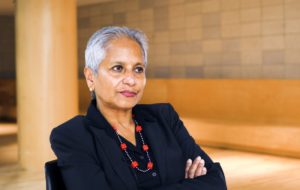
Welcome Remarks by Anla Cheng, The China Project CEO:
SupChina CEO Anla Cheng at the #NextChina opening: we are often “confounded” by the incredible changes in China, and we all are enthusiastic to learn more. pic.twitter.com/mEAipbeiiF
— The China Project (@thechinaproj) January 17, 2018
Morning Keynote by Michael Chu, global CEO of private equity firm L Catterton:
"If you want to see what the U.S. consumer looks like in five years, go to China today." —Michael Chu at #NextChina
— The China Project (@thechinaproj) January 17, 2018
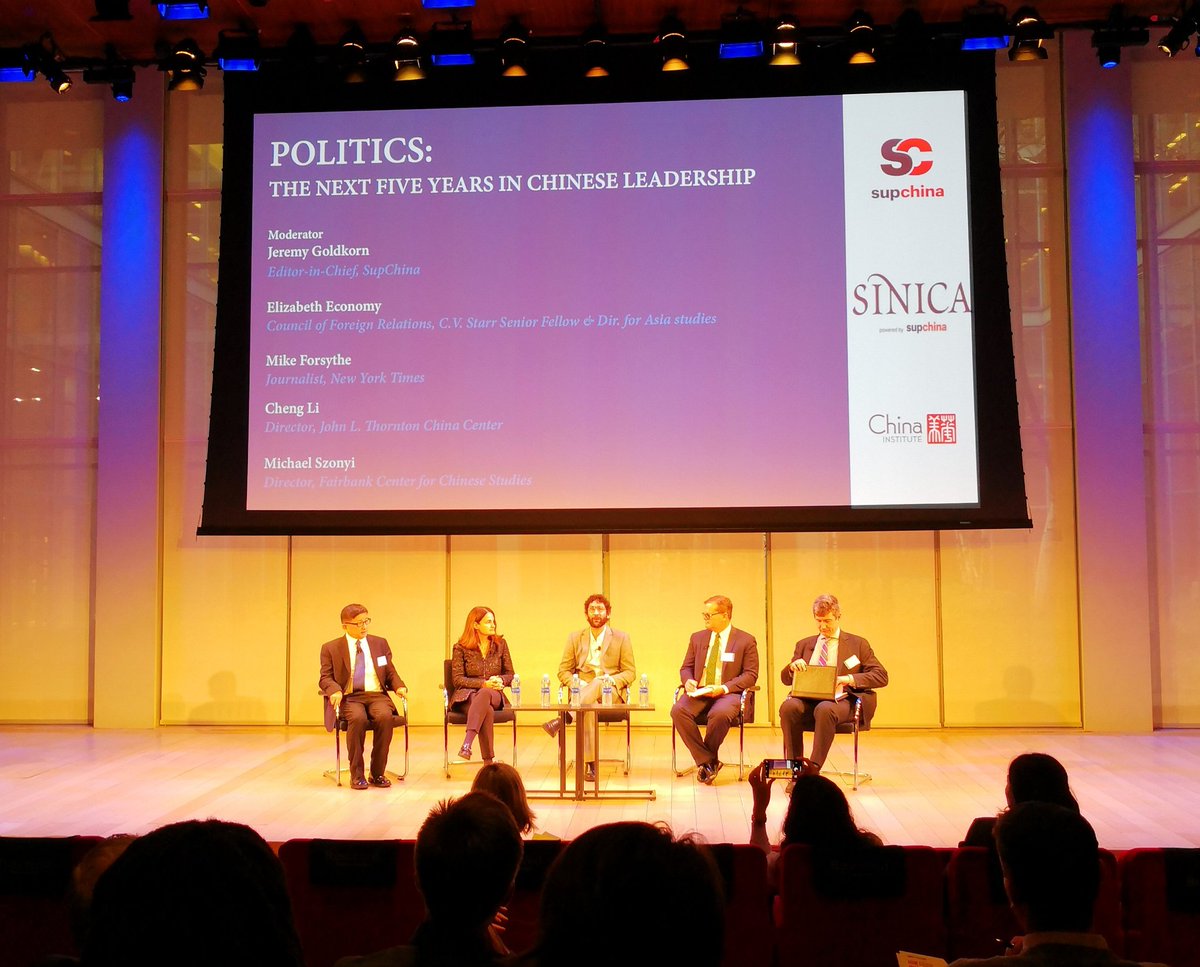
POLITICS: The Next Five Years in Chinese Leadership, with Cheng Li, director of the John L. Thornton China Center; Mike Forsyth, New York Times reporter; Elizabeth Economy, expert on Chinese domestic and foreign policy; and Michael Szonyi, director of the Fairbank Center for Chinese Studies and professor of Chinese history at Harvard University; moderated by Jeremy Goldkorn, The China Project editor-in-chief:
@PekingMike says the Middle East serves as a good barometer for Chinese Global leadership in an interesting panel at #NextChina w @LizEconomy @MichaelSzonyi ans Cheng Li of @BrookingsInst pic.twitter.com/jhf77DOrKx
— Zak Dychtwald (@zakdychtwald) January 17, 2018
At #NextChina conference, Cheng Li of Brookings: Plays down the absence of named successor, saying more importantly term limits and age requirements (7 up 8 down — retirement at 68) still remain.
— Kaiser Kuo (@KaiserKuo) January 17, 2018
Xi Jinping outlined three pillars of legitimacy, says @LizEconomy at #NextChina:
1. Robust and clean communist party
2. Continued economic growth, but more green and more tech
3. International leadership— The China Project (@thechinaproj) January 17, 2018
"The fact that we don't know what happened (five years ago, at 18th party congress) should be quite concerning to all of us." – @PekingMike at the #NextChina conference. "When you don't have competing parties, you have factions."
— Kaiser Kuo (@KaiserKuo) January 17, 2018
"China has done enormously well in the last 30 years by staying agnostic" on many world challenges, but it won't be able to do that anymore —@MichaelSzonyi at #NextChina
— The China Project (@thechinaproj) January 17, 2018
Oh, and:
Who does it better at #NextChina @goldkorn or @MichaelSzonyi? pic.twitter.com/j0LyX6TfQ6
— The China Project (@thechinaproj) January 17, 2018
MACROECONOMICS: Outlook for 2018, with Stephen Roach, formerly chairman of Morgan Stanley Asia and its chief economist; Andy Rothman, investment strategist at Matthews Asia; Donald Straszheim, senior managing director at Evercore ISI; moderated by Dinda Elliott, director of the Center of Business at China Institute. Andy Rothman echoed the message of Michael Chu’s earlier keynote when he observed, “China is the best consumer story on the planet,” noting that total consumption from Chinese households will soon rival U.S. households.
Andy Rothman makes the bullish case on China, notes that for 6th years in a row now consumption was largest piece of GDP. Rebalancing happening: Willingness to change and give up control is cause for optimism. #NextChina
— Kaiser Kuo (@KaiserKuo) January 17, 2018
Don Straszheim says Trump has "No information relevant to his job as president," when it comes to China or trade. Washington knows that a trade war is lose-lose. Will tinker at edges, lots of bark, no bite. #NextChina
— Kaiser Kuo (@KaiserKuo) January 17, 2018
"The bipartisan support for going after China has a deep and long history," Stephen Roach reminds us at #NextChina
— The China Project (@thechinaproj) January 17, 2018
Long-term worries of the economists on our #NextChina panel are largely political: lack of rule of law, one-man strongman rule, potential isolation of Chinese market because of protectionism.
— The China Project (@thechinaproj) January 17, 2018
PHILANTHROPY: How Does Giving Amongst Chinese on Two Continents Differ, with John Long, CEO of Highridge Partners; Shirley Wang, founder and CEO of Plastpro Inc.; Walter Wang , chairman and CEO of JM Eagle and Quenan Group (China); Lulu C. Wang, founder and CEO of Tupelo Capital Management; Vivian Long, director of programs for the Long Family Foundation (LFF); Crysti Chen, co-founder and managing partner at UniWill Ventures; Adley Chan, assistant professor of clinical occupational therapy in the USC Chan Division of Occupational Science and Occupational Therapy; Ben Niu, president of Laoniu B & S Foundation; moderated by Betty Liu, anchor on Bloomberg TV:
Gen 1 speakers on #NextChina philanthropy panel point out how giving in China is very pragmatic and focused on specific problems (such as one disease), but Chinese-Americans give to institutions in communities for longer-term, broader benefits.
— The China Project (@thechinaproj) January 17, 2018
Gen 2 speakers on #NextChina philanthropy panel say that new Chinese and Chinese-American givers are more global-minded, more interested in innovation, and good at raising awareness through social media.
— The China Project (@thechinaproj) January 17, 2018
Lunch Keynote by Peter Walker, retired senior partner of McKinsey & Company:
Peter Walker of McKinsey & Company gives the lunchtime keynote at #NextChina pic.twitter.com/CJLLZqginH
— The China Project (@thechinaproj) January 17, 2018
FINANCE and INVESTMENTS: Joseph Zeng, CEO of Greenwoods Asset Management HK; Eric Almeraz, CFA and co-founder of Apis Capital Advisors, LLC in 2004; Yong Ma, executive vice president of Bank of China New York; Kenny Tjan, country head of Value Partners Asset Management Singapore; moderated by Wendy Cai, partner at Oenus Capital:
"China needs to develop intellectual property internally… because it's going to be very difficult to go overseas and buy it." —Eric Almeraz at #NextChina
— The China Project (@thechinaproj) January 17, 2018
"I think we're just focusing on 3 percent of the market" when we see home prices rise so fast in first-tier cities and conclude there's a bubble. Smaller cities have much more moderate price increases, says Kenneth Tjan at #NextChina
— The China Project (@thechinaproj) January 17, 2018
TECH: China vs. U.S. Tech — Who Leads? with Anna Fang, CEO and partner of ZhenFund, an early-stage venture capital firm in China; Savio Tung, recently retired as the chief investment officer of Investcorp; Frederick Demopoulos, co-founder of Qunar, who has been deeply involved in the Chinese media and internet industries for over 10 years; moderated by Kaiser Kuo, The China Project editor-at-large:
"Capital becomes the barrier to entry" for on-demand services in China. Once two or three successful players emerge, then VCs all pile on and new players can't get funding, @annafanghamm says #NextChina
— The China Project (@thechinaproj) January 17, 2018
American tech entrepreneurs have a massive blind spot for China, panelists agree at #NextChina. Every Chinese VC, on the other hand, visits the U.S. at least once a year. @annafanghamm sees curiosity increasing about China, but not nearly enough
— The China Project (@thechinaproj) January 17, 2018
HEALTHCARE: The Future of Private Healthcare in China, with Roberta Lipson, CEO and founder of United Family Healthcare (UFH); John Foster, 37-year veteran of private equity investing; Peikwen Cheng, co-founder of Yiviva, a clinical-stage biotech company launched out of Yale University; Chun Meili, director at both Community Global Insights and Johnson & Johnson; moderated by James P. McCarron III, a partner at Innovating Global Health:
"The second child policy has been a boon to [United Family Healthcare], but at the same time, it has made 2017 a really bad year for infant death." Many older mothers wanted another child, and hospitals had no experience with second births, Roberta Lipson says #NextChina
— The China Project (@thechinaproj) January 17, 2018
"Medicine is medicine, it doesn't matter if it's east or west. If it does good, we should figure out ways to increase access." —Peikwen Cheng on his medical philosophy #NextChina
— The China Project (@thechinaproj) January 17, 2018
FIRESIDE CHAT: U.S.-China space relations — featuring Leroy Chiao (@AstroDude), a former NASA astronaut and International Space Station commander; moderated by Merit Janow, an internationally recognized expert in international trade and investment.
Next up, a fireside chat with @AstroDude, moderated by Merit Janow of @ColumbiaSIPA #NextChina pic.twitter.com/Oq9Qc3sPWJ
— The China Project (@thechinaproj) January 17, 2018
"That's something a lot of people don't understand: The People's Liberation Army runs the entire manned space program" in China. But "I don't see it as a roadblock to collaboration." —@AstroDude at #NextChina
— The China Project (@thechinaproj) January 17, 2018
.@AstroDude points out that the pessimists were wrong about Russians joining Americans on space missions: Relations improved with the program, and U.S.-China relations could benefit from space collaboration as well #NextChina
— The China Project (@thechinaproj) January 17, 2018
Sinica Live Podcast: Jeremy Goldkorn and Kaiser Kuo with Yukon Huang , a senior fellow at the Carnegie Endowment for International Peace in Washington, D.C.:
And finally, a live @SinicaPodcast at #NextChina featuring Yukon Huang of @CarnegieEndow, and of course, your hosts, @goldkorn and @KaiserKuo. Look for it in your podcast feed soon! pic.twitter.com/9WHA4yyHwi
— The China Project (@thechinaproj) January 17, 2018