Stocks plummet as COVID-19 spreads across Asia and Europe
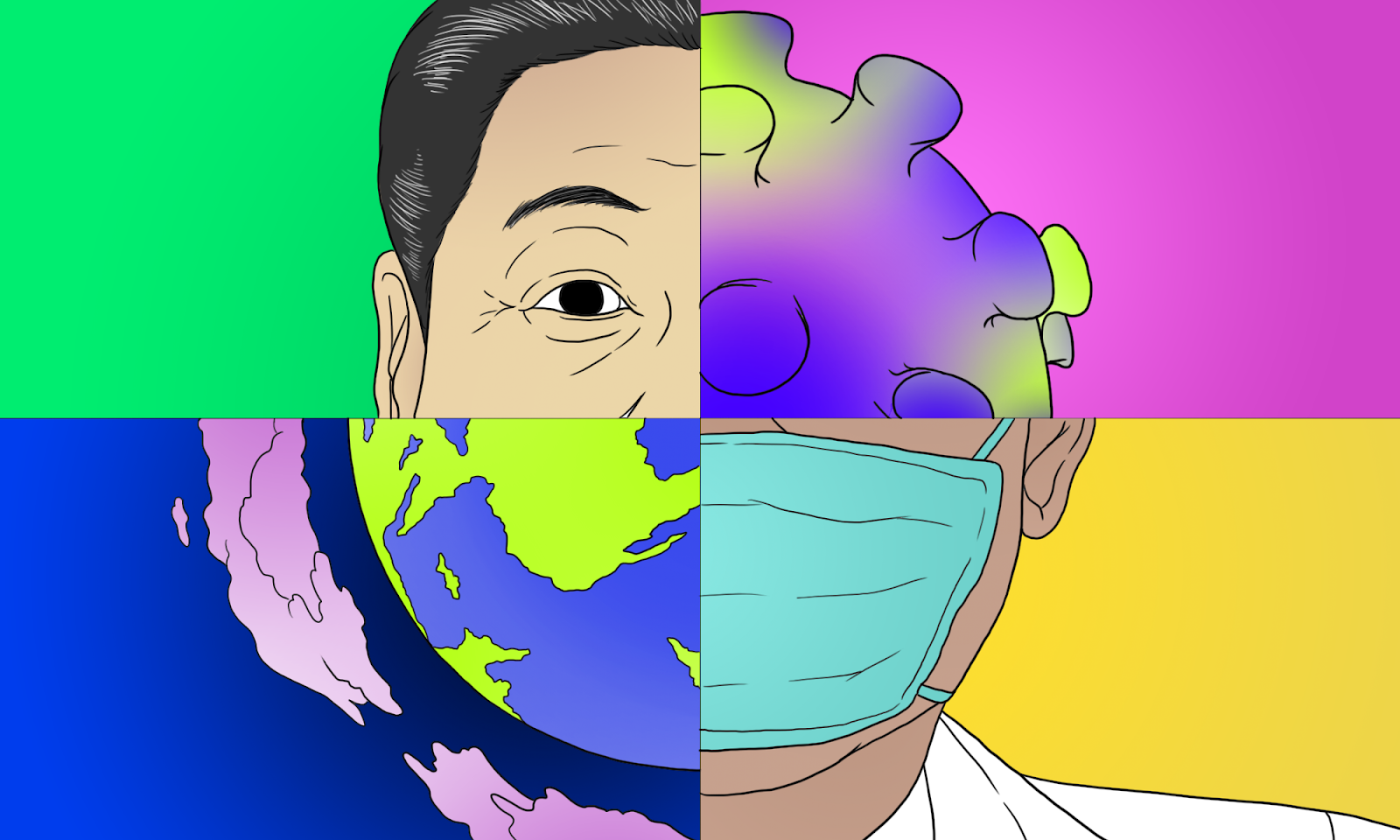
The China Project illustration by Derek Zheng
The COVID-19 outbreak reached its peak in China last week, at least according to government numbers, although the official numbers of infections and deaths continue to increase steadily. Beijing is also dialing up the propaganda in an attempt to build confidence in the central leadership.
But today “was an ugly day on Wall Street” according to CNBC (February 24). “The Dow closed down more than 1,000 points, its worst day since February 2018. The other major indexes all closed down more than 3% each.”
Until this weekend, investors had shrugged off the threat of the COVID-19 epidemic. A week ago, no countries other than China and Japan — where a single cruise ship became a hotbed for hundreds of COVID-19 cases — had more than 100 infections.
But fears of a pandemic animated the markets today. Besides that cruise ship where over 600 were infected and three have died, South Korea has now reported over 800 infections, Italy has 230, Japan has 159, and over 50 cases and 12 deaths were reported in Iran.
See also Hong Kong stocks tumble as virus cases spiral outside China, in Nikkei Asian Review (porous paywall).
Impact on China’s economy
China’s top leader Xí Jìnpíng 习近平 admitted yesterday, per the SCMP, that the COVID-19 epidemic would have a “considerable impact of the Chinese economy and society,” though he insisted that “the fundamentals of China’s long-term economic growth have not changed, and the impact of the epidemic is short term and overall controllable.”
Others are not as optimistic. See, for example, this Wall Street Journal report (paywall) that begins:
The Chinese economy’s quick return to normal will hinge largely on how migrant workers such as Zhang Hua choose between two bad options: Stay in their hometowns without jobs, or return to cities where they face a 14-day coronavirus quarantine before being allowed back to work…
China’s transport minister recently said fewer than one-third of the country’s 291 million migrant workers, or people from rural areas who work in cities, had returned to their jobs as of February 14. He said another 120 million should return by the end of February, while the remaining 100 million would return in March.
Chinese companies hoping to reopen after the COVID-19 shutdown are also facing a barrage of administrative paperwork before they can get the all clear from the government.
Confusion in Wuhan and repression of critical voices
While the leaders in Beijing try to project calm, citizens living in the epidemic epicenter in Wuhan are receiving mixed messages. The South China Morning Post reports that “just three hours after announcing that visitors trapped in Wuhan…could leave on Monday, authorities reversed the decision, saying it had been made without approval.” The city has also “introduced 14 days’ mandatory quarantine for recovered coronavirus patients, after some discharged patients again tested positive.”
Authorities have also cracked down on anyone questioning their approach. Police have detained Xǔ Zhìyǒng 许志永, “a prominent activist and legal scholar who issued a blistering attack on president Xi Jinping for mishandling the coronavirus crisis amid.” Law professor Xǔ Zhāngrùn 许章润, who also published a public critique of Xi, was placed under house arrest for days and is now barred from the internet. At least two citizen journalists in Wuhan are reportedly detained.
Ban on wildlife trade
Finally, a bit of good news: “China said it will ban the trade and consumption of wild animals…as part of efforts to curb virus outbreaks,” the SCMP reports.