This is a takeover.

Welcome to Access if you just subscribed this week! If you haven’t also joined us on the instant-messaging service Slack, check your email inbox — you should have received an invite from my colleague Lucas. Come and join our conversation! We have live “office hours” at 11 a.m. EST every Thursday, but send in questions and comments or just introduce yourself anytime.

 The government takes over Anbang, owner of the Waldorf Astoria
The People’s Daily reports (in Chinese) that the acquisitive insurance group Anbang has been taken over by the China Insurance Regulatory Commission (CIRC), which will maintain control over it for one year. CIRC says it will continue normal operations and protect consumer rights. Anbang’s billionaire chairman, Wu Xiaohui 吴小晖, has been charged with ”economic crimes,” and CIRC says that “illegal business practices” may threaten the solvency of the company. CIRC’s statement is here (in Chinese).
Anbang was founded in 2004 in Beijing as a property insurance business. The state-owned Shanghai Automotive Industries (SAIC) and state-owned oil company Sinopec each hold about a 20 percent stake in Anbang. The company leaped to international prominence in 2014 with a string of international acquisitions, most prominent of which was the purchase of New York’s iconic Waldorf Astoria hotel.
Everything started to go south in June last year, when Wu Xiaohui was taken away on June 9 by the relevant organs (被有关部门带走 bèi yǒuguān bùmén dài zǒu) — in other words, detained by the authorities. There has not been much news about Anbang since then, until today.
Although Anbang has been under government scrutiny for some time, Bloomberg says that “the takeover still came as a shock,” noting that just last week, the CEO of the Hilton hotel group, which manages the Waldorf Astoria hotel for Anbang, “downplayed talk that the Chinese insurer was selling the hotel.” Now, says Bloomberg, “Hilton will find itself working with the Chinese government.”
Other reports on the Anbang affair:
-
The Guardian: Chinese government takes over troubled insurance giant Anbang
-
Washington Post: China seizes control of troubled insurer that owns Waldorf Astoria
-
CNN: China seizes control of insurer that owns the Waldorf Astoria
-
New York Times: Beijing takes over Anbang, insurer that owns Waldorf Astoria (paywall)
-
Reuters: China stocks shrug off seizure of Anbang amid signs of state support
The never-ending debate about Beijing influence in Australia
Since last year, the chattering classes of Australia have been debating the dangers of influence operations and espionage directed from Beijing.
-
The latest salvo comes from Mandarin-speaking former prime minister Kevin Rudd, who argues that current prime minister Malcolm Turnbull has done an “about-face on China, from apologist to McCarthyist.”
-
Rudd also says that his government had “a systematic, comprehensive, whole-of-government national China strategy,” whereas “Turnbull has lurched from one extreme to the other.” He characterizes Turnbull’s new posture on China as “a simple political opportunity to look hairy-chested, to paint Labor [Rudd’s party] as a pack of fifth columnists for the Chinese Communist Party, and through his jihad against ‘agents of influence’ smear the 1.2 million strong Australian-Chinese community and their loyalty to Australia.”
-
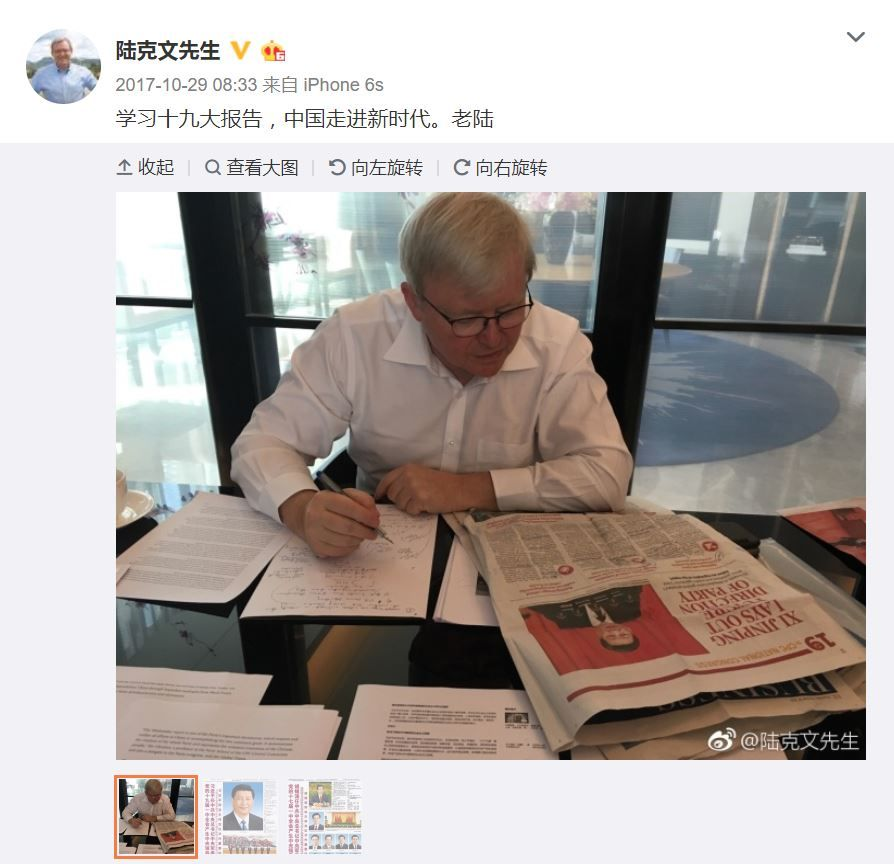
It’s not clear how seriously Rudd’s comments will be taken in Australia. Some of his countrymen may remember his recent Weibo post — since deleted — in which he says he is studying the Party’s report from the 19th Congress, and repeats Xi Jinping’s “New Era” catchphrase.
-
Our recent reports on the Beijing influence debate in Australia: The growing Australian backlash against Chinese influence, ‘Beijing is livid’ over ‘racist’ criticism from Australia, and The anxiety of Chinese influence.
A message for you, our dear Access member
Next week, we will start live chat sessions on Slack with special guests, and you’ll be able to ask subject experts any question you like. I’ll email you as soon as we have times confirmed.
Note that this is the link for the The China Project Access Slack channel. Bookmark it for easy access! Slack also has a mobile app for iOS and Android, which you can set up to give you notifications (if you so desire) when there is conversation happening on the Access channel.
We really appreciate your support as Access members. Please chat with us on Slack, contact me at jeremy@thechinaproject.com, or reach out to our whole editorial team at editors@thechinaproject.com anytime. We love feedback!
—Jeremy Goldkorn, Editor-in-Chief

-
Communist Party politicking
Key Beijing meetings coming up / Axios
“Just ahead of the annual ‘Two Meetings’ in early March, the Communist Party’s Central Committee (CPCC) may hold the Third Plenum — a move that would be unexpectedly earlier than normal in the year and could highlight Chinese President Xi Jinping’s resolve to implement reforms.” -
Cars
BMW plans to build battery electric Minis in China / ABC
China’s Geely is buying $9 billion stake in Daimler / Bloomberg -
Chinese investment in America
American semiconductor firm Xcerra calls off sale to Chinese fund after hitting U.S. regulatory wall / SCMP
“The two firms decide to end the US$580m deal as regulatory approval is unlikely.” -
Detained Hong Kong bookseller Gui Minhai (?)
37 EU politicians demand Beijing ‘unconditionally’ release detained Hong Kong bookseller Gui Minhai / SCMP
‘A very scary movie’: how China snatched Gui Minhai on the 11.10 train to Beijing / Guardian -
U.S.-China relations and Liu He 刘鹤
China’s top economic aide Liu He heading to U.S. in bid to defuse trade tensions / SCMP
Xi confidant emerges as front runner to head China’s central bank / Reuters -
North Korea
China probes report of possible North Korea sanctions breach at sea / Reuters
China-North Korea trade falls to near four-year low in January as sanctions bite / SCMP
Trump announces harsh new sanctions against North Korea / NYT (paywall)
“The measures target 27 shipping companies and 28 vessels, registered in North Korea and six other countries, including China.” -
Free trade and internet sovereignty
United States tells WTO of concerns over China’s new web access rules / Reuters -
Internet companies
Momo buys Tantan, China’s Tinder, for $600M as Chinese social networks consolidate / TechCrunch -
Oddballs
Japanese war uniform prank lands Chinese duo behind bars / SCMP -
Mobile networks
China’s Huawei set to lead global charge to 5G networks / Reuters -
Pakistan
Podcast: China acts as peacemaker in Pakistan’s Balochistan / FT
A free short podcast episode with Farhan Bokhari, Kiran Stacey, and James Kynge, Financial Times journalists who worked on a report (paywall) this week stating that China has secretly negotiated for four to five years with separatist militants in an area where it has billions in investments to protect. -
Belt and Road (?)
The latest Belt and Road Monitor newsletter / RWR Advisory Group
A useful, regular review of Belt and Road developments drawn transactional data and other research.
 BUSINESS AND TECHNOLOGY
-
Tencent’s biggest investor is a little-known South African media group
Tencent, once an obscure messaging service of little interest outside China, is now one of the world’s largest internet companies and one of the largest of any kind by market capitalization. Its largest investor, a South African media company called Naspers, is unusual in many ways. -
How brands use fake followers on Chinese social media
Fake followers are a “fundamental part” of Chinese social media. Weibo bots make up as much as 40 percent of the platform’s active users, triple the proportion on Twitter. But most Western brands have no clue about the role of bots on the Chinese internet when they first open their accounts. -
China’s box office enjoys another record-smashing Spring Festival holiday
Moviegoing has become a national pastime for the Chinese during the Spring Festival. As of Wednesday, the movies that debuted in China’s theaters during the Chinese New Year holiday have racked up a cumulative $882 million, nearly twice as much as the box office gross during this period last year. Also: MC Tianyou has been banned from livestreaming.
POLITICS AND CURRENT AFFAIRS
-
U.S. Secret Service denies it tackled Chinese official during Trump visit to Beijing
U.S. Secret Service agents tackled a Chinese security official during a scuffle in Beijing in November as the American military aide carrying the “nuclear football” was refused entry to the Great Hall of the People, according to Axios. The Secret Service denied that the incident took place, but the rumors run deep. -
The anxiety of Chinese influence
Anne-Marie Brady, a New Zealand scholar who has published on Chinese overseas influence operations, had her office and home broken into and her contacts in China questioned by police. She and New Zealand’s prime minister suspect these facts may all be connected. Meanwhile, Australia and the U.S. continue to debate about how to respond to Beijing’s overseas influence. -
The Quad vs. China’s Belt and Road
The American government is coordinating with Australia, Japan, and India to counter China’s infrastructure plans (the Belt and Road), the Australian Financial Review reported. The “Quad” is looking to deepen its security and economic cooperation since resuming meetings last November after many years. -
U.S. reinforces its relationship with Taiwan as part of a pushback on Beijing’s influence
As Taiwan faces new tests in its relationship with mainland China, the U.S. is standing by Taiwan as part of its pushback on Beijing’s regional influence. A congressional delegation visited Taipei this week to convey its “love for Taiwan,” while an arms sale forum in Taiwan and upgrading of the American Institute in Taiwan are planned for this summer.
SOCIETY AND CULTURE
-
Peter Wang, hero to some
A 15-year-old boy who was killed, along with 16 others, in a school shooting in Florida last week was revealed to be Chinese American and to have spent part of his childhood in China. This earned him a prominent story in China’s People’s Daily, though on social media, the reaction to his death was mixed and muted. -
Chinese supermodel Liu Wen in a controversy for wishing her Instagram followers ‘Happy Lunar New Year’
Thirty-year-old Chinese model Liu Wen 刘雯 is under fire for not wishing her 3.7 million Instagram followers a “Happy Chinese New Year.” Instead, she wrote “Happy Lunar New Year.” -
Terracotta warrior’s stolen thumb triggers outrage from China
The theft of a thumb of a 2,000-year-old terracotta warrior on display in the U.S. has provoked anger from Chinese internet users and the cultural relics authority of the city of Xi’an, which called for “severe punishment” to be imposed on the perpetrator.
ON SUPCHINA
 China has no problem with racism, and that’s a problem
Zheng Churan, one of China’s Feminist Five, comments on CCTV’s recent Africa skit and the racism of the country’s newly rich.
-
Also on The China Project: Black Lives China comments on ‘Africa’ sketch in CCTV gala, and from The China Project’s Anthony Tao, China’s CCTV Spring Festival Gala included a truly shameless Africa skit, featuring blackface.
China Sports Column: How badly was China screwed in short-track speed skating?
Short track is “the fast and the furious” of the Olympics and is notoriously unpredictable. But for the expectant Chinese public, there was something fishy going on. Time and again, Chinese skaters were penalized while their Korean counterparts were given a pass. It all came to a head in the women’s 3,000m relay final, which ended in massive controversy. Also in this week’s column: The NBA’s JJ Redick gave a truly baffling Chinese New Year’s greeting, and Ping-Pong debuted at the New York Philharmonic.
The China Project Quiz: Modern Chinese History, Late Qing and Republican Era
Take a 12-question quiz about modern China, from the late Qing dynasty to the Republican Era, featuring the likes of Sun Yat-sen, the Empress Dowager Cixi, Zhang Xueliang, Hong Xiuquan, and many more. Tweet your score at us @supchinanews!
Did you REALLY just ask me ‘Are Chinese girls easy?’
A story we published last week on how Chinese internet users interpret the ugly stereotype of the Asian “easy girl” provoked a far-ranging and spirited discussion across our channels. Yajun Zhang offers her response.
Video: The DACA crisis and a Chinese Dreamer
While the majority of DACA recipients are from Mexico, 200,000 come from countries in Asia, Europe, and the Caribbean. In this video, Antonio tells his story of being a Chinese-American DACA recipient.
The laws that prompt motorists to kill injured accident victims
On October 13, 2011, a vehicle knocked down two-year-old Wang Yue 王悦 on a narrow street in Foshan. As she lay on the ground underneath the van, the driver paused for a second, pulled forward, and ran over the little girl again. The case is not the first nor the last of its kind, as China seems to have a history of drivers trying to kill pedestrians, often by running over them multiple times, after they make the first hit.
-
If you are in New York City next Monday, February 26, come to a live taping of the Sinica Podcast: Courts & Torts: Driving the Chinese Legal System
Sinica Podcast: The China Questions, with Jennifer Rudolph and Michael Szonyi
Two China historians discuss their new book: a collection of answers to many questions that ordinary people ask about China, written by the star team of scholars at the Fairbank Center for Chinese Studies at Harvard University.
-
Subscribe to the podcast via Apple Podcasts, Overcast, or Stitcher.
PHOTO FROM MICHAEL YAMASHITA
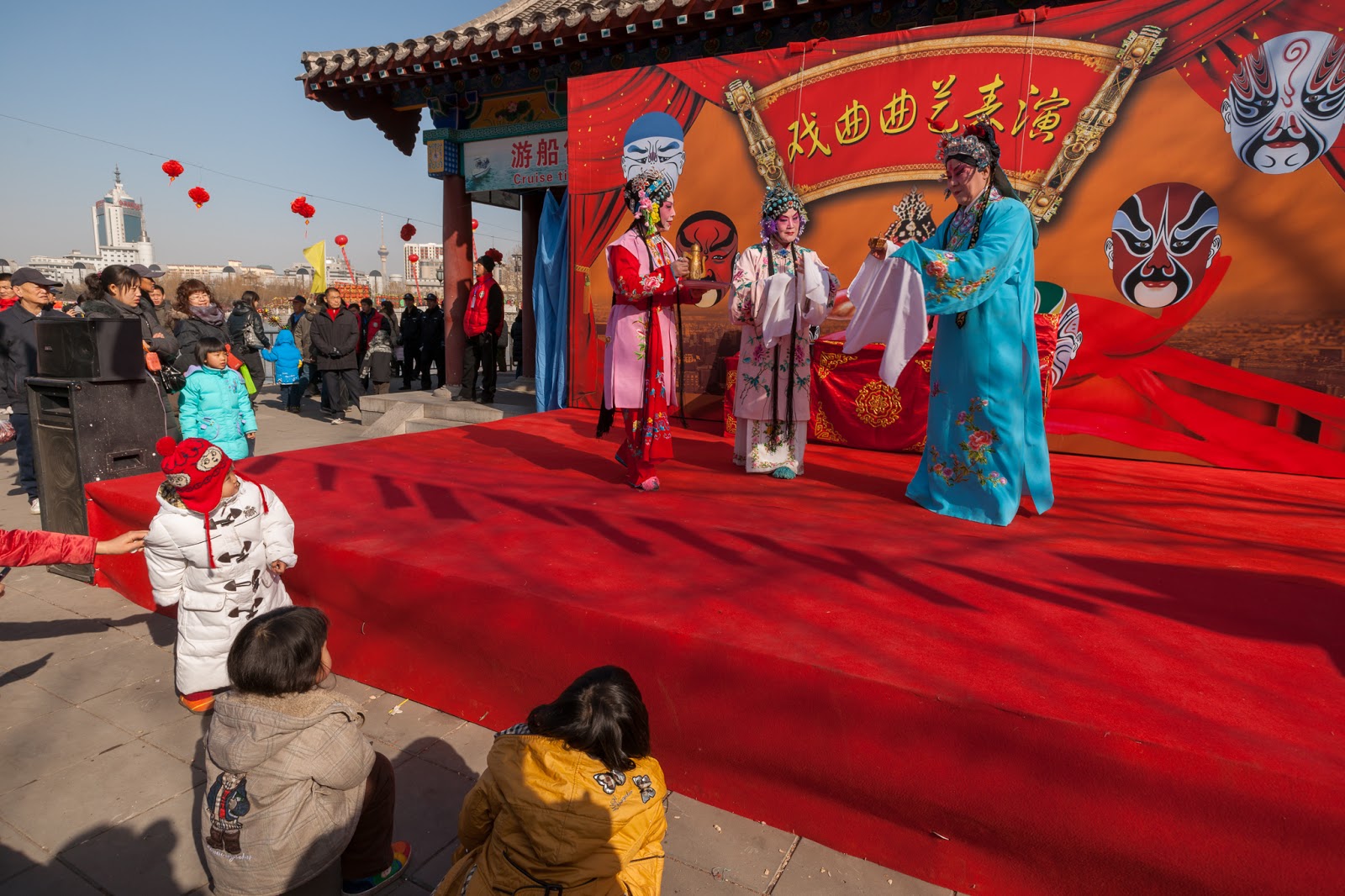 Peking opera
Peking Opera actors perform at a temple fair in Lianhuachi Park in Beijing during the Spring Festival in 2010.
—Jia Guo