For four days in October 1937, citizens of Shanghai’s International Concession witnessed a desperate last stand. Across the small river of Suzhou Creek was a robust concrete warehouse standing at the edge of a wasteland of shelled buildings and crooked telephone poles.
It’s one of modernity’s most bizarre battles, one of the opening volleys of the Second Sino-Japanese War. Both sides — the Chinese and Japanese — wanted to win over the international community, so both tried to ensure life in the neutral Concessions remained as normal as possible. The distance between big city lights and burning rubble was less than 70 meters.
Today, the Sihang Warehouse, still scarred with bullet holes, has become a shrine: the rampant popularity of a new cinema blockbuster means tickets to visit are sold out five days in advance. The men who defended it are known as the “800 Heroes” (actually 414; inflating troop numbers was a good tactic to psych out the enemy), defending the last corner of unoccupied downtown Shanghai while the Chinese army fell back.
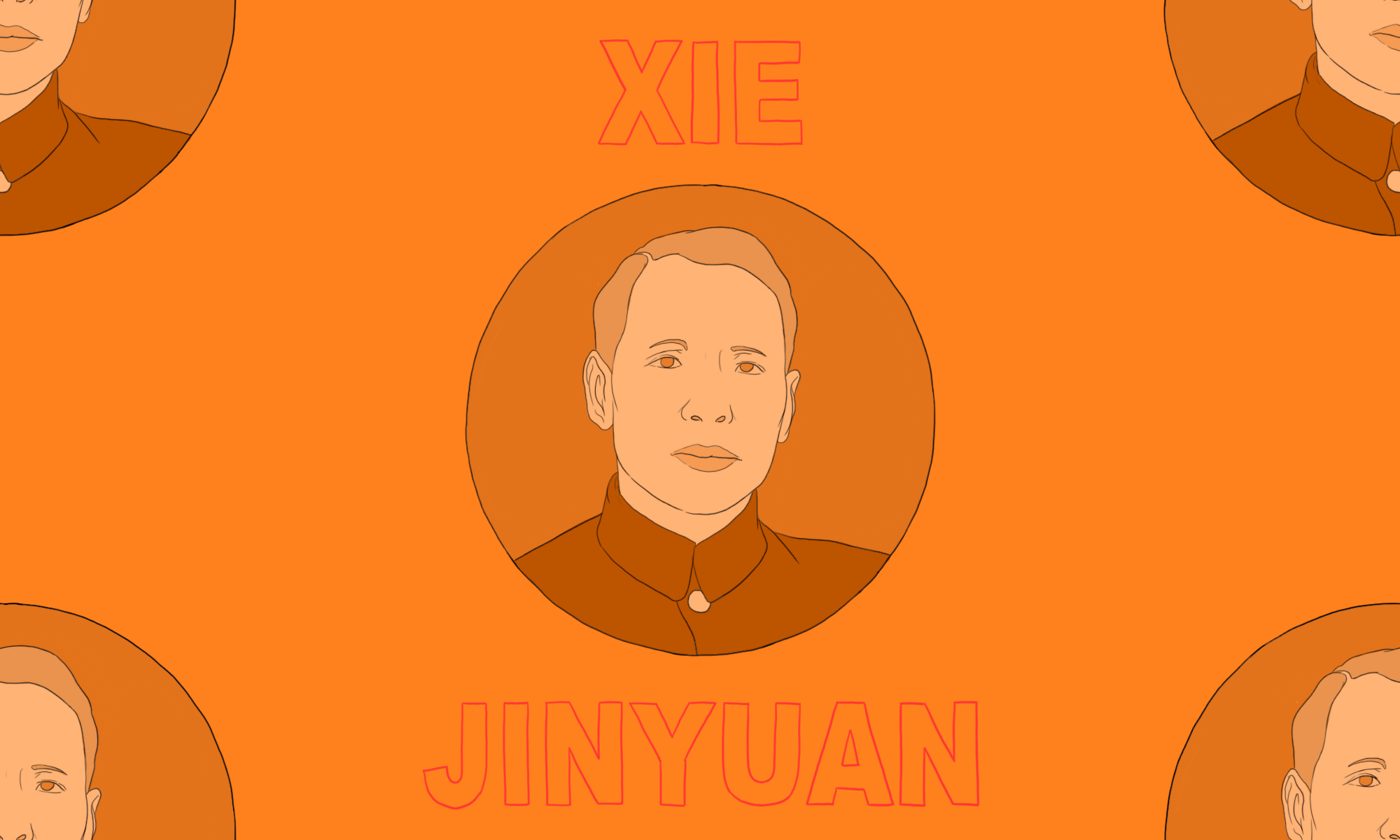
Their story of strength in defeat has parallels to the retreat at Dunkirk, a legend of resilience and righteousness deployed in service of the dangerous nationalism of today’s China. The legend finds embodiment in the leader of this band: Xiè Jìnyuán 谢晋元.
Who is Xie Jinyuan?
He was always a man of patriotism and duty. Despite humble beginnings (his mother was the daughter of a fisherman), he showed academic promise and insisted on diligence in his studies. A Westernized education introduced him to the patriotic ideas of Sun Yat-sen (孙中山 Sūn Zhōngshān).
But Xie was dismayed when China broke into regions ruled by warlords. He enrolled in the Whampoa Military Academy (an important officer training school whose graduates became key commanders in the KMT and CCP) and from 1926 worked his way up the ranks of the Nationalist Revolutionary Army, setting brave examples during the slow reclamation of China in the Northern Expedition.
Then the Japanese invaded. Xie took part in the fighting as they infiltrated from the East. He was seriously injured during a foray in 1929 in Shandong. He took part in the so-called “January 28th Incident,” a brief Shanghai skirmish in 1932 — again setting a brave example and promoted to Lieutenant Colonel.
By the Battle of Shanghai in August 1937, he was a hardened veteran of the 88th Division; German-trained, they were amongst the best in the Chinese army. When the Japanese broke through Chinese lines, Chiang Kai-shek turned to the 88th for a group of men to buy the army time to retreat. The man chosen to lead them would have to be firm and very courageous. Outnumbered and outgunned, survival wasn’t guaranteed. It would have to be a man willing to die for China.
A Shanghai Thermopylae
The place for this last stand was the art deco Sihang Warehouse. It was sturdy, the Division’s HQ and one of the highest points in the area. Chiang hoped the world would witness China’s fighting force at its best from across Suzhou Creek.
Xie seems to have set himself up for martyrdom, repeatedly telling witnesses he would fight to the death. “The warehouse is our last position, or our grave,” he supposedly told troops before the siege. “As long as we have one person, we must fight the enemy to the end!”
It was a grueling battle. Shanghainese could see the carnage of total war out of their own windows. “It was as though Verdun had happened on the Seine, in full view of a Right Bank Paris,” wrote American journalist Edgar Snow.
At night “4-inch shells fired at almost point blank range into the concrete walls,” reported the North China Daily. “The sharp crack of rifles, the dull thud and momentary flash of hand-grenades, the awe-inspiring sudden flash of steel projectiles tearing their deadly way through the building, the staccato chatter of heavy machine-guns, the ‘dot-dot-dot’ of tracer bullets, and finally the blood-red glow of fire in an upper-storey.” One of Xie’s subordinates later reckoned that on the final day there was a shell landing every second.
There were feats of outstanding bravery from Xie’s men. They raised a Republic of China flag on the roof and fiercely defended it from attack. One soldier tied explosives to his waist and plummeted from a window into a crowd of Japanese, killing himself and 20 men.
It seems likely these tales of high-flying bravery are not just the work of later myth-makers. “It is significant that even though defection across the Suzhou Creek was not impossible,” says Peter Harmsen, author of the New York Times bestseller Shanghai 1937: Stalingrad on the Yangtze, “there is not evidence of any defender leaving the battle before time.”
But on October 31, Chiang ordered a retreat. Xie initially resisted, but orders were orders. At midnight they retreated into the Concessions. British soldiers immediately took their weapons and placed them in custody — international laws of neutrality dictated they be detained (plus the Japanese had threatened recriminations if they weren’t).
As the Japanese swept into the interior, Xie and his men were grounded in rusty tin sheds. As peace collapsed into World War II, Xie fought insomnia and depression with a rigid daily regimen for himself and his troops — rising at 4:30 for morning exercises, lessons and sports strictly scheduled. He upheld fierce discipline and corporal punishment for transgressions, with a daily flag-raising ceremony to remind his men of their duty to the nation.
The siege, along with his refusal to let his troops languor in captivity, was an inspiration. He refused offers of freedom, as they involved collaboration — Chinese were “never slaves.” He was visited by Chinese who listened to his insistence that a century of international bullying had been caused by a lack of patriotism. War was the only response to regain respect and safety. “We are [currently] at other people’s mercy like fish or meat on a chopping board,” he said. “People of a weak nation are despised everywhere. How can we stop fighting and spilling blood?” He even became the subject of a patriotic song insisting “China will not die” if they followed his fighting example.
In April 1941 Xie was stabbed by four of his own men while overseeing the usual early morning jog. Supposedly these men were acting for Wāng Jīngwèi 汪精卫, head of the Chinese collaborationist government, but they also had their own grievances: the troops were poor and unable to properly feed themselves.
His death bolstered morale. Both Máo Zédōng 毛泽东 and Chiang Kai-shek praised his fighting spirit — one that was essential to “revolutionary” zeal — and 10,000 turned out to his funeral.
The guns of August
There was little room for the 800 in Mao’s Second World War mythology, reserved for Communist fighters. Xie’s tomb in Shanghai was desecrated during the Cultural Revolution, old members of the 800 brutally punished for their role in counter-revolution.
But since the 1980s, rehabilitation has been in full swing. The Ministry of Civil Affairs officially made Xie a martyr of the war in 2015. This year has seen the release of the hugely popular film The Eight Hundred (八佰 bā bǎi), a gung-ho account of the siege, which has made 2.4 billion yuan ($350 million) since its release last month.
It was delayed a year for edits and a better anniversary. “This year, 75 years since VJ day, the CCP wanted to put forward a narrative that emphasizes cross-party resistance against the Japanese” with a film that panders to “patriotic nostalgia,” says Professor Rana Mitter of the University of Oxford, author of the new good China’s Good War: How World War II is Shaping Chinese Nationalism. As Mitter points out in his book, memory of the Second World War (in comparison to, say, the Cultural Revolution or the final years of the Qing) is being nurtured in China, portrayed as a time when the nation was “strong and victorious, as well as morally righteous.”
The film emphasizes the aggression displayed throughout the war by Japanese: mustard gas and aerial dive-bombing are added to their armory, even though there’s no evidence either were deployed in the siege. “It is highly unlikely that the Japanese would have deployed poison gas so close to the International Settlement,” says Peter Harmsen. Symbolic of the excesses of the trenches and banned in warfare by international law, “the side that could be proven to be using gas would be a big loser in the competition for the hearts and minds of the Western publics.”
Reminders of Japanese cruelty lends weight to idolizing those brave enough to resist. They could even be a way of redeeming the nation. “You are the true Chinese,” says a commanding superior to Xie, tears in his eyes, as he orders the withdrawal. Those who collaborate or run away apparently don’t count.
This mentality is easily weaponized in state media, history used to thread a string of foreign-based “others” together. Although The Global Times says The Eight Hundred will make audiences “cherish the peace,” the writer deploys their sacrifice against Hong Kong protester Agnes Chow. Credentials of her treachery include asking support from Japan on social media, “in the invaders’ very own language.” “Secessionists like Chow need to go to the cinema to see what Japan did to their grandparents decades ago. Hopefully, they may actually learn something from the movie if their blood still carries a bit of sense of being Chinese.”
It’s dangerous to be glamorizing war while saber-rattling is entering state media. As one Chinese commentator notes on Douban: “Excellent war films express a firm anti-war sentiment…to remind the world that there should be no more war in this world. But our war films are always stuck in strong patriotism, using the fearlessness of the military to wake up the boiling blood of the Chinese people — ‘the Chinese people cannot be bullied!’”
The new popularity of Xie Jinyuan and his 800 could be a disturbing omen. It fits the desire to prove that China is no longer a “weak nation” populated by “sick men.” That the war with Japan is an unsettled score. That conflict can be a “just” response to whatever Xi Jinping considers foreign “bullying.” Such thinking is for countries that are “meat on a chopping board,” not a superpower with a cleaver of its own.
Chinese Lives is a weekly series.