Trade war, day 160: Is Beijing softening Made in China 2025?
Since March, when the U.S. Trade Representative (USTR) released its “Section 301” report on Chinese trade practices, the Made in China 2025 initiative has been in focus as what The China Project called the “true heart of the U.S.-China trade war.”
The initiative sets a number of ambitious but non-binding goals to reduce China’s reliance on foreign technology, and directs investment into ten strategic areas, including robotics, artificial intelligence, aerospace equipment, and quantum computing. American officials railed against the policy because, to them, it represented a declaration that China’s cutthroat practices to achieve technological power — including market protectionism and state subsidization, as well as what the USTR said was a massive amount of intellectual property theft and forced technology transfer — would never change.
The Wall Street Journal reports today (paywall) that Beijing is now working on a new, less aggressive “replacement” for Made in China 2025:
- Broadly, the new plan “would play down China’s bid to dominate manufacturing and be more open to participation by foreign companies,” the Journal reports.
- It could be announced early next year, or about halfway through the current 90-day negotiating period.
- “Odds are long that the new plan will go far enough in addressing U.S. complaints…some U.S. officials are likely to see the changes as more cosmetic than real.” And Jeremie Waterman, president of the China Center at the U.S. Chamber of Commerce, said that it should be judged “not against new slogans and broad formulations,” but based on “very detailed concerns regarding subsidies, standard setting, procurement and others.”
- But the changes could be significant, even if they end up short of the Trump administration’s demands.
- One change under consideration is “dropping the numerical targets for market share by Chinese companies.” The core goal of the current plan is “raising domestic content of core components and materials to 40% by 2020 and 70% by 2025, an increase that comes at the expense of foreign competitors.”
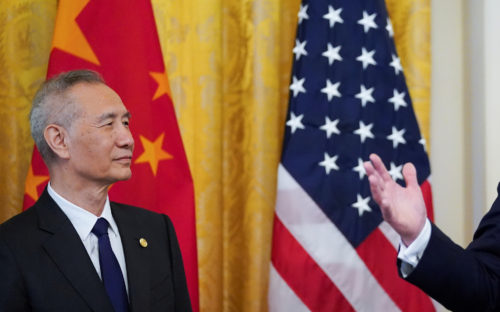
- Any shift to a more market-based approach would not be too surprising. The WSJ notes that Liú Hè 刘鹤, China’s economic “mastermind” and Beijing’s point person for current trade talks, has “criticized Made in China 2025” for creating overcapacity in some sectors.
- The concept of “competitive neutrality,” or treating state-owned and privately-owned companies the same, is also reportedly gaining traction in Beijing, though entrenched interests would be tough to overcome and this would be a reversal from the trend in recent years.
- Made in China 2025 is already being deemphasized, Caixin reports:
China’s central government has updated its list of priorities [in Chinese] for local governments to focus on — and the controversial ‘Made in China 2025’ industrial strategy is off the list…
One notable change from the 2016 list is the government’s greater emphasis on ‘promoting steady growth of foreign trade and foreign investment,’ as China faces headwinds from trade tensions with the U.S…
Though Made in China 2025 was left out, the list included policies that support independent innovation, high-technology industries and industrial transformation.
Why would China want to be open to foreign investment in its high-tech industry, when all year, Xi Jinping has been increasing the drumbeat for “self-reliance” and indigenous technological innovation?
The Financial Times provides (paywall) what could be a clue, related to the booming semiconductor manufacturing industry in China:
While Beijing has been pouring billions into the industry to catch up…the percentage of locally-produced equipment used by China’s chipmakers actually declined to around 5 per cent last year from 8 per cent in 2015 as local suppliers failed to keep up with the country’s fleet of semiconductor foundries and assembly and testing factories.
As much as Beijing wants to go it alone to upgrade China’s industries, it probably recognizes that outside investment and foreign technology inputs are necessary at least for the next few years.
More trade-war-related news:
- Hacking concerns
Marriott data breach is traced to Chinese hackers as U.S. readies crackdown on Beijing / NYT (porous paywall)
“The cyberattack on the Marriott hotel chain that collected personal details of roughly 500 million guests was part of a Chinese intelligence-gathering effort that also hacked health insurers and the security clearance files of millions more Americans, according to two people briefed on the investigation.
The hackers, they said, are suspected of working on behalf of the Ministry of State Security, the country’s Communist-controlled civilian spy agency.” - Interesting commentary from former WTO director general
‘Trump will achieve nothing with tariffs’: former WTO head blasts US policy on China / SCMP
Pascal Lamy, director general of the WTO from 2005-2013: “Trump is probably wrong on everything he does in trade except for one thing, which is the need to reform the WTO…But we are talking about changing the rules of the game, and that can’t be done bilaterally. It has to come from a multilateral discussion.”
“If you compare the rhythm of China’s opening up reforms today to what it was when it joined the WTO in 2001, it has certainly slowed down. Although the official discourse remains committed to it, for the moment we see more talk than walk. And, particularly with Xi Jinping, the country has moved towards more centralisation.”
Lamy also comments on the arrest of Meng Wanzhou, saying, “is related to the fact that the US, because of its supremacy, can afford to have a system of extraterritorial sanctions applying to a number of countries, including Iran and Russia among others.” - EU complains about “forced tech transfer”
Forced tech transfers must stop or be regulated: EU ambassador to China / CNBC
Nicolas Chapuis, ambassador of the EU delegation to China: “Of course if a company wants to open its tech books to a Chinese company — all right, that’s not an issue, but it has to be regulated so that there is no so-called ‘forced tech transfer.’” - Economic stats
China’s November export, import growth shrinks, showing weak demand / Reuters
China’s currency on track for biggest fall in two months / FT (paywall)
Analysts warn China financial situation remains weak despite rise in bank lending / SCMP
Stocks, Yuan rise on U.S.-China trade optimism: Markets wrap / Bloomberg (porous paywall) - Southeast Asia
Vietnam uses US-China trade war to rebalance its economic and security relationships / SCMP - Quantum computing technology
A Chinese step forward in quantum computing / Xinhua
“China’s first quantum computer control system with independent intellectual property rights has been launched in Hefei, capital of eastern Anhui Province, sources with the city’s high-tech zone said yesterday.
The system was developed by Origin Quantum Computing Technology Co, a startup which develops and commercializes quantum computers.”
U.S. intelligence sounds the alarm on the quantum gap with China / Yahoo News
“According to one recently retired national security official focused on emerging threats presented by advanced technology, China is on track to be 20 years ahead of the United States in the not-too-distant future. Another national security official said the United States is currently scrambling to defend itself, hoping to find foolproof ways to protect its everyday communications in the worst case.” - Global effects of tariffs
Increase in tariffs and import duties to US$588 billion could threaten global economy, World Trade Organisation warns / SCMP
Previously in The China Project’s trade war coverage: